Concrete Canvas vs. Shotcrete: What Are the Differences?
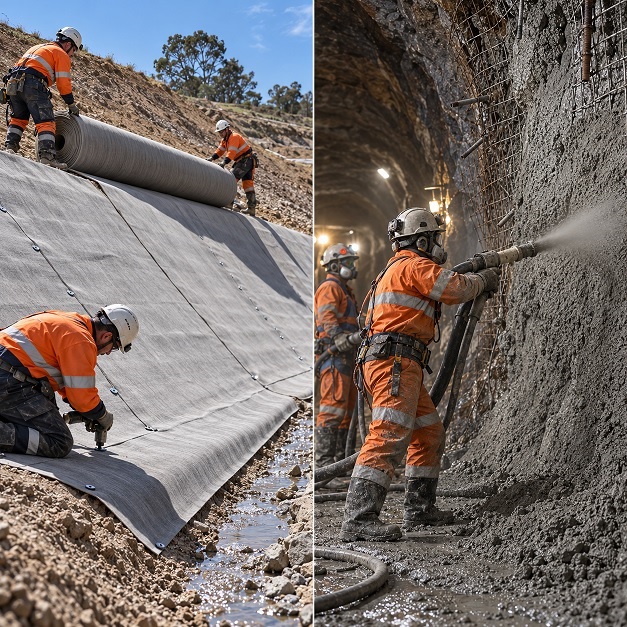
In mining, infrastructure, and geotechnical projects, surface protection is an important aspect of maintaining site conditions in accordance with design requirements. Two methods commonly used in certain applications are Concrete Canvas and shotcrete.
Both use cement-based materials, but they differ in installation methods, material forms, equipment requirements, and application characteristics. Therefore, comparing Concrete Canvas vs. shotcrete is not simply a matter of determining which material is stronger, but also which method is more suitable for specific project conditions.
What Is Concrete Canvas?
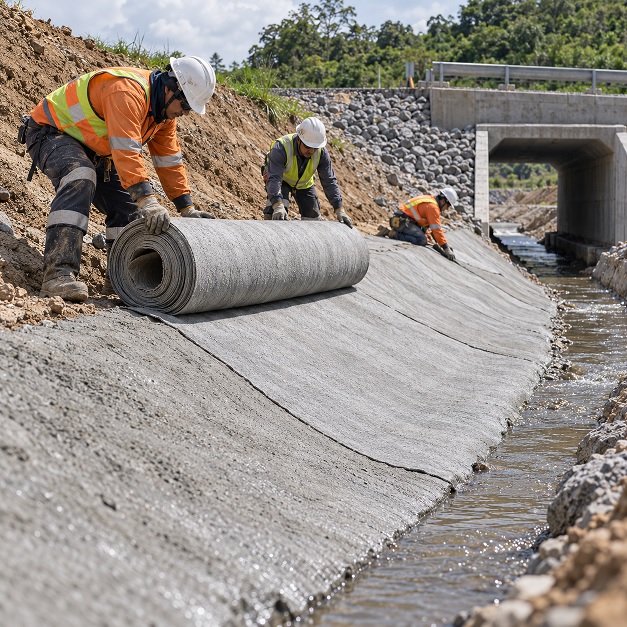
Concrete Canvas is a type of Geosynthetic Cementitious Composite Mat (GCCM). It is a flexible mat or sheet containing cementitious material.
During installation, Concrete Canvas is placed over the surface that requires protection. The material is then activated with water according to the installation procedures. It subsequently undergoes hydration and hardening, forming a cementitious layer.
These characteristics make Concrete Canvas suitable for various surface protection applications, including:
- Channel lining
- Drainage channel protection
- Erosion control
- Slope protection
- Drainage systems
- Selected infrastructure applications
One of its advantages is that the material is available in rolls, making it easier to transport and position at the project site before the hydration process begins.
What Is Shotcrete?
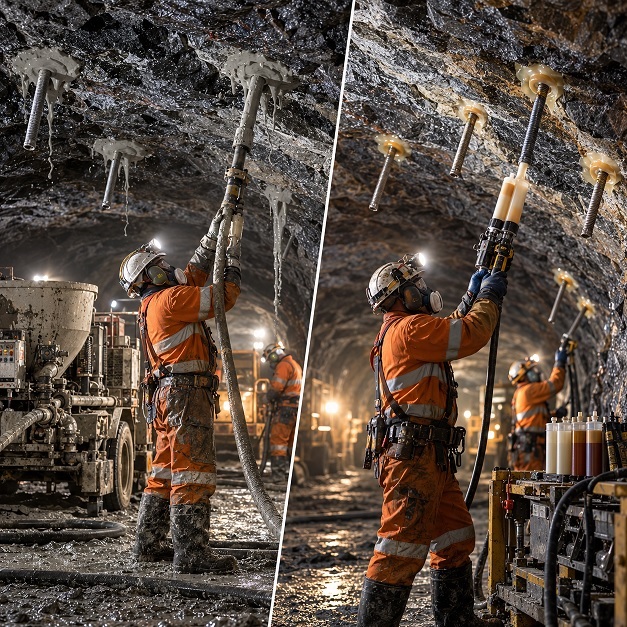
Shotcrete is a method of applying concrete or mortar by spraying it onto a surface under high pressure.
Unlike Concrete Canvas, which is supplied in mat form, shotcrete requires a concrete or mortar mixture that is applied using spraying equipment.
Shotcrete is widely used in construction and geotechnical works, including applications that require a concrete or mortar layer on specific surfaces.
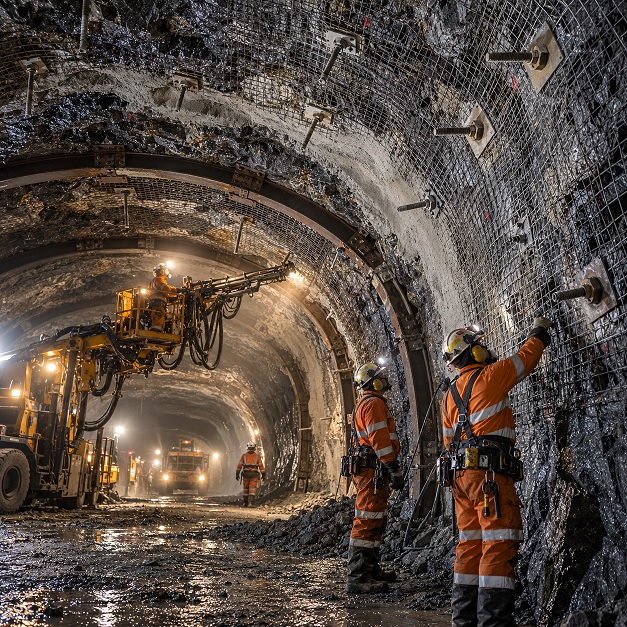
In mining projects, shotcrete can also form part of a ground support system or surface protection solution, depending on the engineering design.
Differences Between Concrete Canvas and Shotcrete
Although both can be used for surface protection, there are several important differences between these methods.
1. Material Form
The first difference lies in the form of the material.
Concrete Canvas is supplied in mat or roll form and can be unrolled across the surface.
Meanwhile, shotcrete consists of a concrete or mortar mixture applied by spraying it onto the surface using specialized equipment.
These differences in material form result in different preparation and installation methods.
2. Installation Method
Concrete Canvas is first positioned over the area requiring protection and then activated with water according to the specified procedures.
Shotcrete requires the material to be sprayed onto the surface using machinery and a suitable pressurized system.
Consequently, labor requirements, equipment, site accessibility, and project preparation may differ between the two methods.
3. Equipment Requirements
Concrete Canvas can be installed using equipment that differs from the equipment required for shotcrete applications.
Shotcrete, on the other hand, requires spraying equipment, hoses, nozzles, and other supporting systems.
At sites with difficult access, equipment requirements are an important factor to consider during the initial project planning stage.
4. Surface Characteristics
Before hardening, Concrete Canvas is flexible, allowing it to conform to certain surface contours.
Shotcrete is applied directly by spraying, allowing operators to build up a layer on the surface according to the requirements of the application.
Both methods can be used on specific surface geometries, but their preparation and installation techniques differ.
Concrete Canvas vs. Shotcrete for Erosion Control
For erosion control applications, the choice between Concrete Canvas and shotcrete should take site conditions into account.
Concrete Canvas can be a suitable option for channel lining or surface protection projects that require a cementitious material supplied in mat form.
Once installed and hardened, the resulting layer can help protect the surface against erosion.
Shotcrete can also provide a protective layer on certain surfaces. However, this method requires a spraying process and appropriate equipment.
Therefore, site accessibility and construction methods are important factors when determining the most suitable solution.
Concrete Canvas vs. Shotcrete for Slope Protection
For slope applications, surface conditions and slope gradients must be carefully considered.
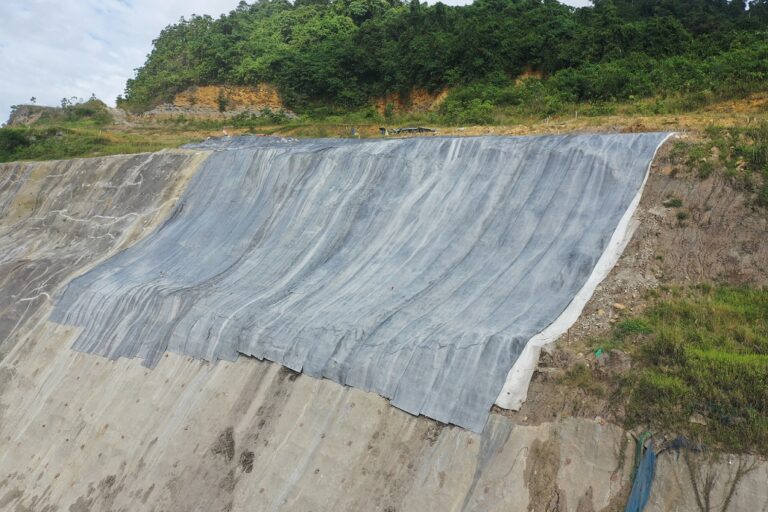
Concrete Canvas can be laid over a slope before being activated and hardened. This method can be considered for surface protection and erosion control applications.
Shotcrete can also be used on slopes to create a cementitious surface layer.
However, the two methods do not always serve identical purposes. Slope protection design must account for overall slope stability, drainage, soil or rock conditions, and the potential for ground movement.
Therefore, neither Concrete Canvas nor shotcrete should be selected based solely on the type of material.
When Should Concrete Canvas Be Considered?
Concrete Canvas can be an attractive option when a project requires a cementitious material supplied in mat or roll form.
Some conditions in which it may be worth considering include:
- The area requires surface protection.
- The project involves channel lining.
- The application requires erosion control.
- Access for transporting conventional concrete materials is a consideration.
- The surface has specific shapes or contours.
- The project requires a sheet-based installation method.
However, actual project requirements must still be evaluated before selecting a product.
When Is Shotcrete More Suitable?
Shotcrete can be considered when a project requires concrete or mortar to be sprayed directly onto a surface.
This method can be used in various construction, geotechnical, and mining applications, depending on the engineering design.
Shotcrete also allows material to be applied to complex surface geometries because it is sprayed directly onto the areas requiring coverage.
When selecting shotcrete, several factors should be considered, including the mix design, required thickness, equipment, site accessibility, and the capabilities of the personnel performing the spraying operation.
Comparison Table: Concrete Canvas vs. Shotcrete
| Factor | Concrete Canvas | Shotcrete |
|---|---|---|
| Material form | Mat or roll | Concrete or mortar mixture |
| Application method | Unrolled and activated with water | Sprayed onto the surface |
| Equipment | Relatively straightforward installation equipment | Shotcrete machinery and equipment |
| Applications | Channel lining, erosion control, surface protection | Construction, geotechnical works, and various concrete applications |
| Flexibility before hardening | High | Material is applied directly by spraying |
| Preparation | Surface preparation and mat placement | Material preparation and spraying system setup |
| Key considerations | Surface conditions and installation method | Mix design, equipment, operator expertise, and surface conditions |
This table provides a general overview. The final selection should be based on product specifications and the engineering requirements of the project.
Can Concrete Canvas Replace Shotcrete?
Not always.
Concrete Canvas and shotcrete have different characteristics and application methods. Therefore, Concrete Canvas should not be considered a direct replacement for shotcrete in every application.
Concrete Canvas is better understood as an alternative cementitious material for surface protection and specific applications.
Shotcrete, meanwhile, serves a wide range of applications that require concrete or mortar to be sprayed directly onto a surface.
When determining which method to use, it is important to identify the primary purpose of the work.
Does the project require channel lining, erosion control, slope protection, or a concrete layer designed to perform a specific structural function?
The answer will help determine which method is more suitable.
Concrete Canvas from Prima Minechem
Prima Minechem provides Concrete Canvas solutions for projects in Indonesia.
Concrete Canvas can be considered for various applications, including channel lining, erosion control, slope protection, and surface protection.
Before selecting Concrete Canvas, project conditions should be evaluated, including the area to be covered, surface geometry, slope gradient, water conditions, site accessibility, and installation method.
Understanding these requirements helps ensure that the appropriate Concrete Canvas type and specifications are selected.
Conclusion
The comparison between Concrete Canvas vs. shotcrete involves more than simply evaluating material strength.
Concrete Canvas is a GCCM supplied in mat or roll form that is activated with water and subsequently hardens. It can be used for channel lining, erosion control, slope protection, and various surface protection applications.
Shotcrete, on the other hand, is concrete or mortar applied by spraying it onto a surface using specialized equipment.
Both methods have different applications. Concrete Canvas is not a universal replacement for shotcrete, and shotcrete is not necessarily the most practical solution for every surface protection project.
To determine the most suitable option, consider site conditions, the intended function of the protective layer, project accessibility, installation methods, equipment requirements, and engineering specifications.
For GCCM requirements in Indonesia, Prima Minechem provides Concrete Canvas, which can be considered for various infrastructure and surface protection applications.