Difference Between Cement Grout and Resin Grout for Ground Support
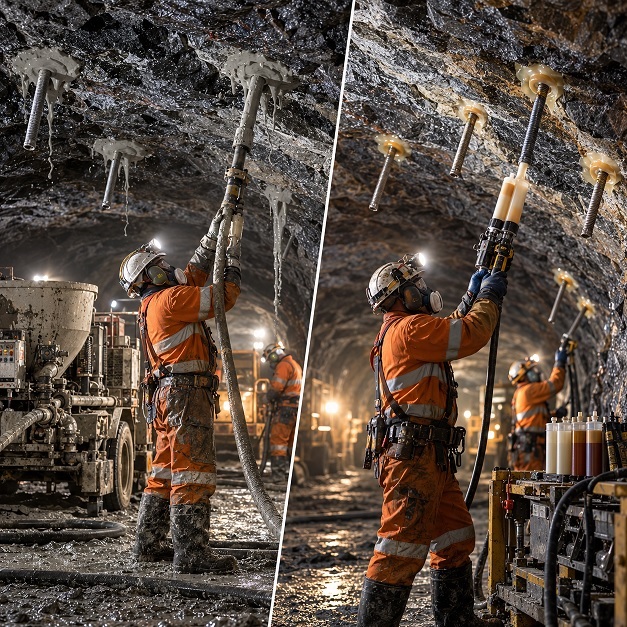
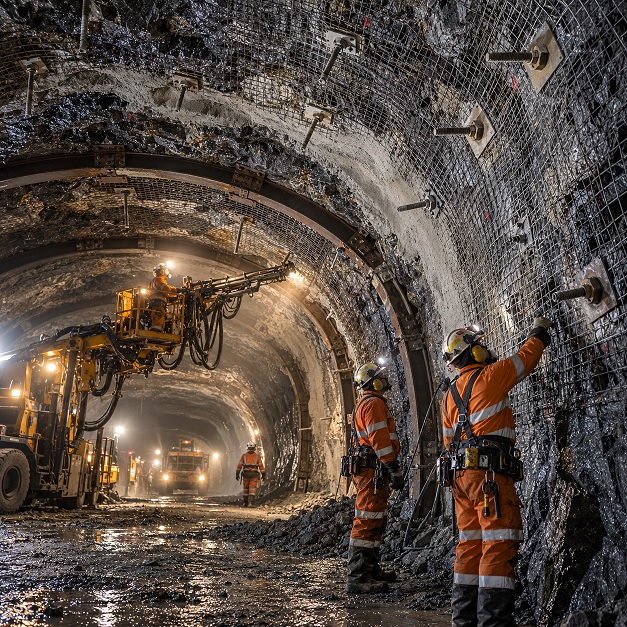
In underground mining operations, rock mass stability is one of the key factors that must be carefully considered. Following excavation, the stress conditions and rock structures surrounding an opening may change. Therefore, an appropriate ground support system is required to suit the geological conditions and operational requirements of the mine.
One component of such a system is grout. Two materials commonly discussed in ground support applications are cement grout and resin grout.
Both materials can be used for certain reinforcement and filling applications. However, they differ in their characteristics, application methods, and usage considerations. So, what are the differences between cement grout and resin grout for ground support?
What Is Cement Grout?
Cement grout is a cement-based material used to fill specific spaces or serve as part of a rock mass reinforcement system.
In mining applications, cement grout can be used for various ground support requirements, depending on the engineering design. The material can be applied using methods that allow the grout to fill designated spaces or areas requiring support.
One important consideration when using cement grout is its curing characteristics. After application, the material requires a certain amount of time to reach the required condition.
Cement grout is also used in various construction and geotechnical applications, meaning its use is not limited to mining operations.
What Is Resin Grout?
Unlike cement grout, resin grout uses resin-based materials.
In mining ground support, resin can be used as part of rock bolting systems and certain stabilization applications. Resin is available in several forms and formulations, including resin capsules and injection resins.
In rock bolt applications, resin can be placed inside a borehole, where it serves as part of the bonding system between the bolt and the rock mass.
Meanwhile, injection resin is applied through an injection process using equipment suited to the material’s characteristics.
Differences Between Cement Grout and Resin Grout
Although their intended applications may overlap in some areas, cement grout and resin grout have several important differences.
1. Material Composition
The most fundamental difference lies in their composition.
Cement grout uses cement-based materials, whereas resin grout uses resin-based formulations.
These differences in composition result in different material characteristics and application methods.
2. Application Methods
Cement grout is generally applied using methods that allow the material to fill designated spaces or areas.
Resin grout is available in a wider range of forms. Resin capsules, for example, can be placed directly into a borehole before the rock bolt installation process. Injection resin, on the other hand, requires an injection process using suitable equipment.
Therefore, equipment requirements and installation procedures must be adapted to the type of grout being used.
3. Curing Time
Curing time is an important factor in ground support operations.
Resin products have specific curing characteristics that can be selected according to application requirements. Cement grout also requires a hardening process after application.
In underground mining operations, curing time must be considered because it can affect work sequences and operational requirements within the mine.
However, actual curing time depends on the product type, formulation, temperature, application conditions, and the manufacturer’s technical recommendations.
4. Product Forms
Cement grout is generally used as a grout material that is mixed and applied according to the specified work method.
Resin, meanwhile, may be available in capsule form or as a material applied through injection.
These differences in product form allow resin to be used in specific applications that require different installation methods.
When Should Cement Grout Be Used?
Cement grout may be considered when a project requires cement-based materials for filling or specific ground support applications.
Key considerations include:
- The type of work being performed.
- The volume of the area to be filled.
- Available application methods.
- Rock mass conditions.
- Required hardening time.
- Available equipment.
- Ground support design.
The selection of cement grout should always follow engineering planning, as requirements can vary from one mining site to another.
When Should Resin Grout Be Used?
Resin grout may be a suitable option for applications that require specific resin characteristics.
One example is the use of resin capsules in rock bolt systems. The resin is placed inside a borehole and used as part of the bonding process between the bolt and the surrounding rock.
Injection resin can also be used in specific applications that require material to be injected into designated areas.
Resin characteristics, such as curing time, mixing method, application temperature, and water conditions, should be considered before selecting a product.
Which Is Better: Cement Grout or Resin Grout?
It is not accurate to declare cement grout or resin grout the overall winner for every situation.
The most suitable material depends on the ground support requirements and project conditions.
If an application requires the characteristics of a cement-based material, cement grout may be an appropriate choice. Meanwhile, if an application requires resin-based material with a specific installation method, resin grout may be more suitable.
Therefore, the selection process should consider:
- Geological conditions.
- Rock characteristics.
- Type of mine opening.
- Installation method.
- Curing requirements.
- Temperature conditions.
- Presence of water.
- Available equipment.
- Engineering design and standards.
This approach ensures that decisions are based not only on material costs but also on how well the material meets the requirements of the work.
Minova Resin Grout for Ground Support
For ground support requirements in the mining sector, Prima Minechem provides Minova solutions, including Capsule Grouts, Injection Resins, and Pumpable Grouts.
These products can be used for different application requirements. Capsule grout can be associated with rock bolting systems, while injection resin and pumpable grout have different application methods depending on project needs.
Prima Minechem can assist mining companies in evaluating material solutions based on their application requirements. Field conditions must still be assessed to ensure that the selected material is compatible with the ground support design and installation procedures being used.
Conclusion
The differences between cement grout and resin grout for ground support can be identified through their composition, product forms, application methods, curing characteristics, and equipment requirements.
Cement grout uses cement-based materials and can be applied to various filling and ground support requirements. Resin grout, meanwhile, is resin-based and is available in forms such as capsules and injection resins for specific applications.
Neither material is always the better choice. Selection must be tailored to rock conditions, ground support design, installation methods, environmental conditions, and mining operational requirements.
For resin-based ground support requirements, Prima Minechem offers a range of Minova solutions, including Capsule Grouts, Injection Resins, and Pumpable Grouts, which can be considered according to specific mining application needs.