Ground Support in Underground Mining: Types and Functions
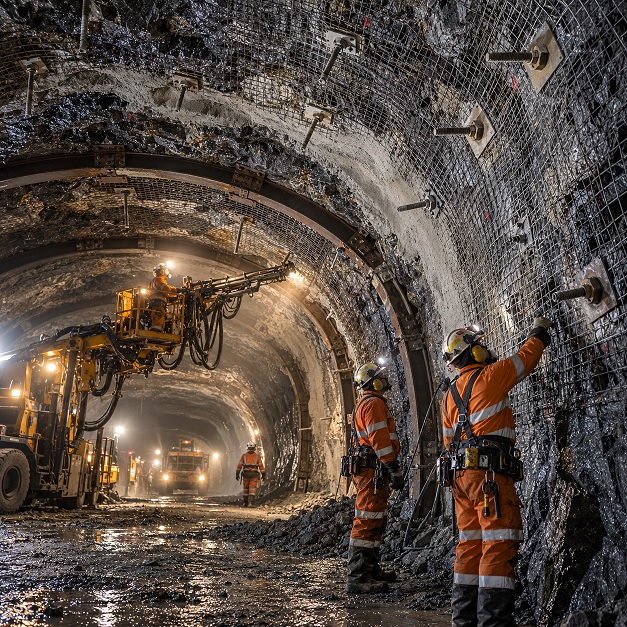
Underground mining presents different challenges compared to open-pit mining. When rock material is excavated to create tunnels, drifts, shafts, or other working areas, the surrounding rock mass conditions can change. Rock pressure, fractures, water, and geological conditions are among the factors that must be considered to maintain excavation stability.
For this reason, ground support in underground mining is an essential part of mining planning and operations. These systems help maintain the stability of the rock surrounding underground openings, allowing mining activities to proceed under more controlled conditions.
Ground support is not simply the installation of a single type of material. Support systems are generally designed based on geological conditions, rock characteristics, mining methods, excavation geometry, and operational requirements at the site.
What Is Ground Support in Underground Mining?
Ground support is a system used to help stabilize the rock mass surrounding underground mine openings.
When rock is excavated, the stress equilibrium previously present within the rock mass can change. Under certain conditions, these changes may cause rock movement, cracking, or rock detachment from the excavation surface.
Ground support helps control these conditions by providing support or reinforcement to the rock mass.
The type of system used may vary from one mine to another. Selection must take into account actual field conditions and the engineering design implemented at the mine.
Why Is Ground Support Important?
Underground openings must remain stable for as long as they are required for mining activities.
Ground support can be part of a strategy to:
- Help maintain the stability of tunnels and mine openings.
- Control rock movement or rock detachment.
- Support workplace safety.
- Maintain access to production areas.
- Reduce potential disruptions caused by rock mass conditions.
- Support the continuity of underground mining operations.
However, ground support systems cannot be separated from an understanding of geological conditions. A system suitable for one location may not be appropriate when applied to different rock conditions.
Factors Affecting Ground Support Selection
Before determining a ground support system, several mining characteristics need to be assessed.
Rock Mass Conditions
Rock quality and characteristics are important factors. Fractures, geological structures, weathering levels, and the mechanical properties of the rock can influence support requirements.
Excavation Shape and Size
Tunnels and underground openings with different dimensions and geometries may require different reinforcement approaches.
For example, the larger the excavation, the more important it becomes to consider how the rock mass will remain stable after excavation.
Depth and Stress Conditions
In deeper underground mines, stress conditions within the rock mass can be an important consideration in support design.
Water Conditions
Water entering the rock mass must also be considered. These conditions may affect material characteristics or the condition of the rock surrounding the excavation.
Mining Methods
The underground mining method used also influences excavation characteristics and the length of time an opening must remain stable.
Because these factors are interconnected, ground support selection should be based on technical evaluation rather than product type alone.
Types of Ground Support in Underground Mining
Ground support systems can consist of various elements. Some reinforce the rock mass, while others help retain or control rock at the excavation surface.
1. Rock Bolts
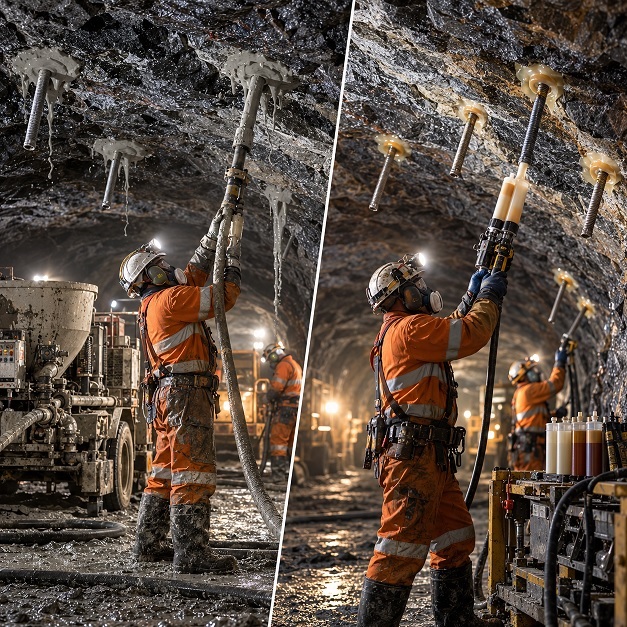
Rock bolts are among the most widely used elements in ground support systems.
In general, rock bolts are installed into the rock mass to help reinforce or bind sections of rock surrounding an excavation.
Rock bolts can be combined with other support materials or systems, depending on mine conditions.
An important consideration is ensuring that the bolt design, length, installation pattern, and installation method are appropriate for the rock conditions and engineering calculations.
2. Resin Capsules
Resin capsules are materials that can be used in rock bolting systems.
The resin material is placed inside a drilled hole and forms part of the bonding system between the bolt and the rock mass after installation.
Resin capsule technology can be suitable for certain applications because the installation process can be relatively fast and adapted to the requirements of the rock support system.
Prima Minechem provides Minova solutions, including capsule grout products for ground support applications in the mining sector.
3. Injection Resins
In addition to capsule grouts, ground support systems can also use injection resins for specific applications.
These materials are applied by injecting them into areas that require filling or stabilization, according to the design and application method.
Injection resins can be used in situations requiring specialized solutions. However, the material type and application method must be selected based on rock conditions and the objectives of the work.
4. Pumpable Grout
Pumpable grout is a grouting material that can be pumped to the application area.
In ground support systems, grout can serve various purposes depending on the design, including filling voids or providing support for specific support elements.
Grout selection should consider material characteristics, application methods, working time, and conditions at the mine site.
Is One Type of Ground Support Enough?
Not always.
In practice, ground support systems may use a combination of several elements to address specific rock conditions.
For example, rock bolts can be combined with grout or resin materials to create a reinforcement system that meets the design requirements.
In other conditions, additional support elements may be required at the excavation surface.
Therefore, the term “ground support” should be understood as a system, rather than a single product or material.
How to Determine the Right Ground Support System
System selection requires technical evaluation. Factors to consider include:
- Rock characteristics at the site.
- Underground excavation geometry.
- Depth and stress conditions.
- Water presence and environmental conditions.
- Mining methods.
- The required service life of the excavation.
- Installation methods and worksite accessibility.
- Mining operational requirements.
In addition to selecting the appropriate products, the installation process must also be considered. Even high-quality ground support materials require correct installation procedures to perform according to their design objectives.
Minova Ground Support Solutions from Prima Minechem
For underground mining applications, Prima Minechem provides solutions from Minova, focusing on ground support and materials for mining applications.
The Minova product portfolio offered by Prima Minechem includes:
- Capsule Grouts
- Injection Resins
- Pumpable Grouts
These three product categories can serve different application requirements, so selection should be tailored to project conditions and the support design being implemented.
Prima Minechem can assist mining companies in identifying material solutions suited to their application requirements. For projects with specific site conditions, material selection, installation methods, and support requirements can be discussed based on the needs of the project.
Conclusion
Ground support in underground mining is an essential part of managing excavation stability. Its purpose is not simply to install reinforcement materials, but to establish a system suited to the characteristics of the rock mass and the operational conditions of the mine.
Rock bolts, resin capsules, injection resins, and pumpable grouts are among the elements that can be used in ground support systems. Selecting the appropriate solution requires consideration of geological conditions, excavation geometry, depth, water conditions, mining methods, and engineering requirements.
For mining ground support applications, Prima Minechem provides Minova solutions, including capsule grouts, injection resins, and pumpable grouts. By assessing project conditions first, material selection can be carried out more accurately and aligned with the requirements of underground mining applications.