In construction projects, not every surface can be effectively treated using conventional cast-in-place concrete methods. Steep slopes, tunnel walls, vertical surfaces, and irregularly shaped structures often require a more flexible approach to concrete application. One of the most widely used methods for these conditions is shotcrete.
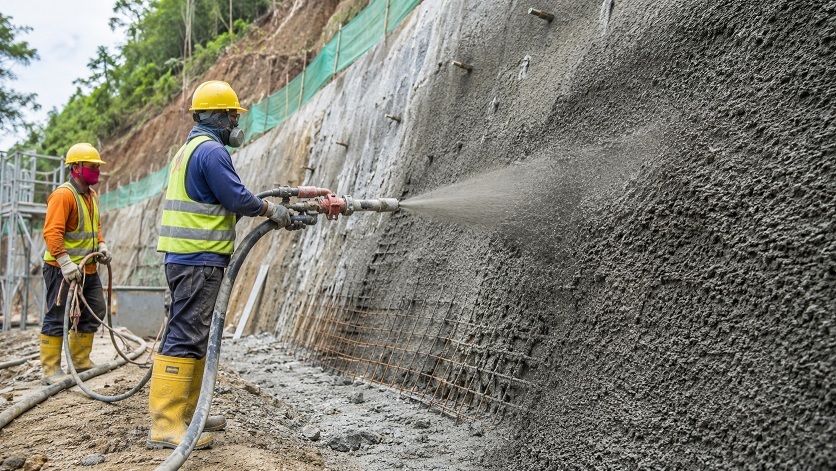
Shotcrete is a concrete application technique in which concrete or mortar is pneumatically projected onto a surface at high velocity. The impact energy generated when the material strikes the substrate helps compact the concrete as it adheres to the surface.
This method is commonly used in new construction, structural rehabilitation, slope protection, mining, tunnel construction, and surface lining applications. While shotcrete offers many advantages, its successful application requires specialized equipment, experienced operators, and engineering designs tailored to the specific conditions of each project.
What Is Shotcrete?
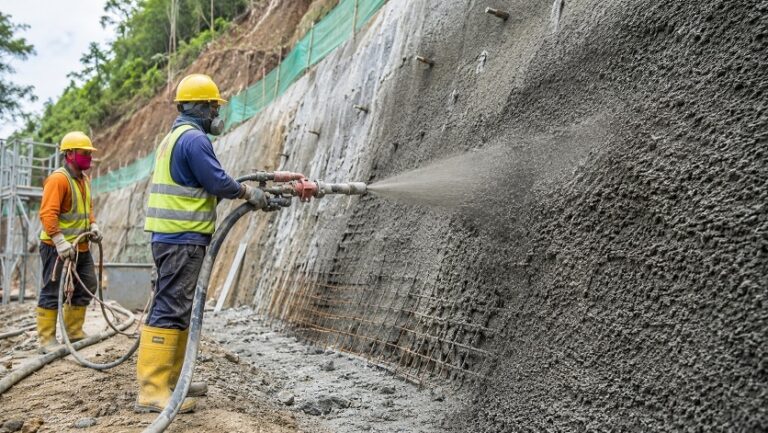
Shotcrete is a method of placing concrete or mortar by projecting it at high velocity through a hose onto a prepared surface. The force of impact compacts the concrete, eliminating the need for conventional mechanical consolidation.
According to the American Concrete Institute (ACI), shotcrete is primarily used on vertical and overhead surfaces. Once hardened, its properties can be comparable to those of conventional cast concrete. However, its application method enables shotcrete to bond effectively to a wide range of substrates while conforming to complex surface geometries.
It is important to note that shotcrete refers to the method of concrete placement, not a specific construction material. The concrete mix must be specifically designed to be pumped through hoses, projected through a nozzle, adhere to the receiving surface, and achieve the required strength after curing.
Shotcrete vs. Conventional Concrete
With conventional concrete construction, fresh concrete is typically poured into formwork before being leveled and consolidated to eliminate air voids prior to curing.
Shotcrete, on the other hand, does not always require full formwork because the concrete is sprayed directly onto the receiving surface. This makes it particularly suitable for vertical, curved, irregular, or difficult-to-access areas where conventional casting methods may be impractical.
However, the need for formwork is not completely eliminated in every application. Depending on the structural design and intended function, certain projects may still require formwork, reinforcement bars, welded wire mesh, anchors, or other supporting components.
The quality of shotcrete installation is also highly dependent on the skill of the nozzle operator. Spray distance, nozzle angle, layer thickness, spraying pressure, and mix consistency must all be carefully controlled to achieve a dense and uniform finished surface.
Types of Shotcrete
Based on the mixing process, shotcrete is generally classified into two methods: wet-mix shotcrete and dry-mix shotcrete.
Wet-Mix Shotcrete
In the wet-mix process, cement, aggregates, water, and admixtures are fully mixed before entering the delivery hose. The wet concrete mixture is then pumped to the nozzle and propelled onto the application surface using compressed air.
This method is commonly selected for large-scale projects because it provides higher production rates and more consistent concrete quality. It also generally produces less dust than the dry-mix process.
Dry-Mix Shotcrete
In the dry-mix process, cement and aggregates are conveyed through the hose in a dry state. Water is introduced only at the nozzle immediately before the material is projected onto the surface.
The nozzle operator plays a critical role in controlling the water content. Insufficient water can interfere with cement hydration and bonding, while excessive water may cause the material to slump or reduce the quality of the finished layer.
According to ACI, the key distinction between the two methods is that wet-mix shotcrete combines all ingredients, including water, before the material enters the hose, whereas dry-mix shotcrete adds water only at the nozzle.
Applications of Shotcrete in Construction Projects
Shotcrete is widely used in projects that require rapid and direct concrete placement.
Slope Protection
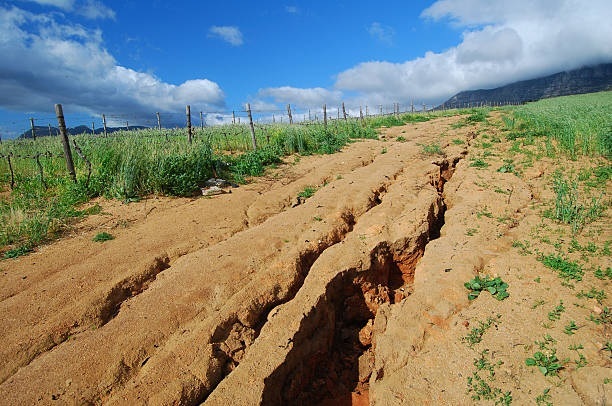
Shotcrete is frequently applied to help protect slope surfaces from erosion. The concrete layer covers exposed soil or rock, reducing surface erosion caused by rainfall and runoff.
Indonesia’s Directorate General of Highways (Direktorat Jenderal Bina Marga) has established specific specifications for shotcrete applications on slopes. The guidelines emphasize that slopes to be covered with shotcrete must already be structurally stable. Therefore, shotcrete should not be regarded as a standalone solution for all slope stability issues.
Tunnel Construction and Ground Support
In tunneling projects, shotcrete is commonly used as an initial support layer immediately after excavation. The material conforms to the rock profile and may be combined with welded wire mesh, steel fibers, rock bolts, or other ground support systems.
Concrete Repair and Rehabilitation
Shotcrete can be used to restore deteriorated concrete surfaces affected by spalling, delamination, or material loss. Before application, all loose or damaged concrete must be removed, and the substrate properly prepared to ensure adequate bond strength.
Construction of Irregular Structures
Because shotcrete readily conforms to complex geometries, it is well suited for curved structures, swimming pools, domes, architectural walls, and other forms that would be difficult or expensive to construct using conventional formwork.
Channel Lining
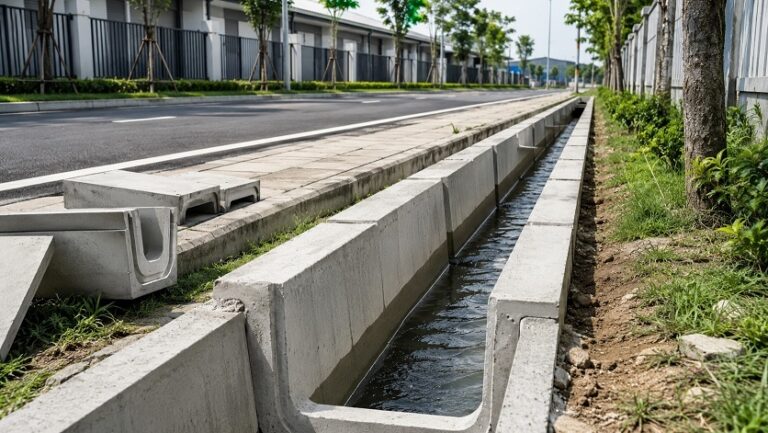
Under appropriate conditions, shotcrete can be used to line water channels, drainage ditches, and hydraulic structures. Proper drainage systems and joint detailing remain essential to prevent hydrostatic pressure from developing behind the concrete lining.
Concrete Canvas as an Alternative for Selected Applications
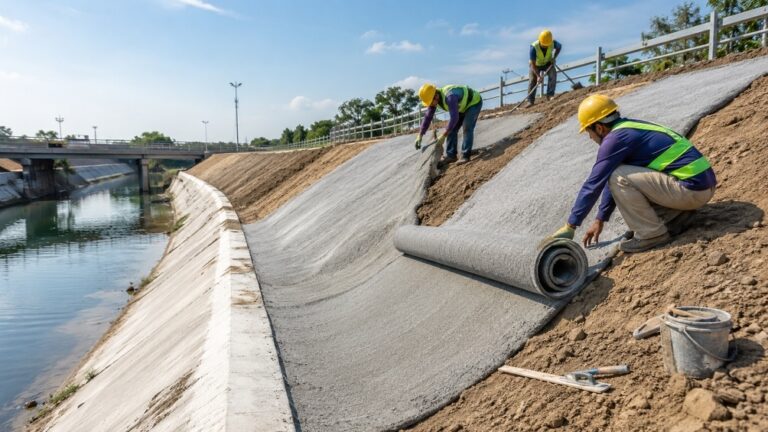
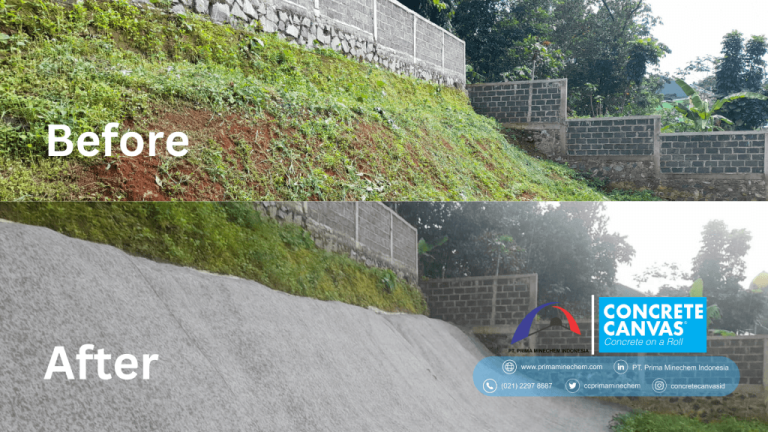
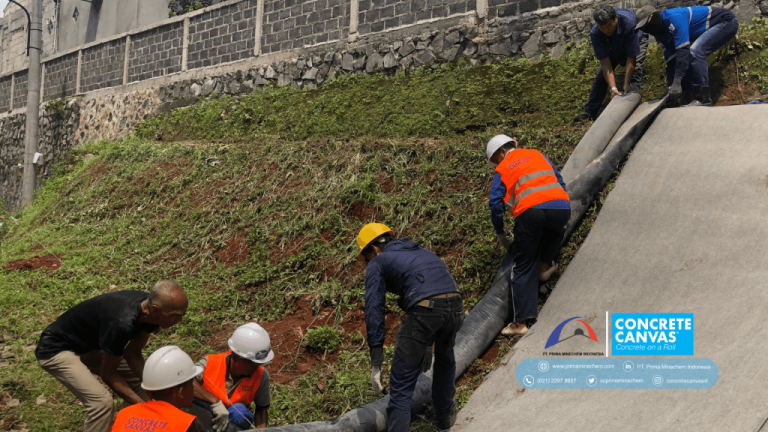
For surface protection, erosion control, channel lining, and slope protection projects, Concrete Canvas may be considered as an alternative to shotcrete. Concrete Canvas is a Geosynthetic Cementitious Composite Mat (GCCM) supplied in flexible rolls. The material is unrolled, secured in place, and hydrated with water, after which it hardens into a durable cementitious layer.
Unlike shotcrete, installing Concrete Canvas does not require spraying concrete onto the surface. This can reduce the need for shotcrete pumps, air compressors, on-site concrete mixing, and the management of rebound material.
In one slope protection project in Gorontalo, Indonesia, shotcrete was initially considered as the preferred solution. However, Concrete Canvas was ultimately selected because it offered faster and easier installation at a site with limited access. The project achieved an installation productivity of approximately 200 to 300 square meters per day with a team of six installers.
Nevertheless, Concrete Canvas is not a replacement for shotcrete in every application. Shotcrete remains necessary for structural concrete works, tunnel support, concrete rehabilitation, and projects requiring greater thickness or specific structural performance. The choice between the two systems should always be based on the project’s engineering design and technical assessment.
Concrete Canvas Solutions from Prima Minechem Indonesia
PT Prima Minechem Indonesia supplies Concrete Canvas solutions for slope protection, channel lining, erosion control, mining, and infrastructure projects. Established in 2012, Prima Minechem is the exclusive authorized distributor of Concrete Canvas in Indonesia.
For contractors and project owners considering shotcrete, Concrete Canvas may be a suitable option for evaluation, particularly where projects involve restricted site access, accelerated construction schedules, or equipment mobilization challenges.
Consult the team at Prima Minechem Indonesia to discuss your project conditions, including surface characteristics, project area, slope gradient, lining function, hydraulic conditions, and technical requirements. A thorough technical evaluation will help determine whether shotcrete remains the most appropriate solution or whether Concrete Canvas can provide a more practical and efficient installation method.